Swedish Processional March

Swedish Processional March

Scharwenka, Xaver, 1850-1924

Langey, Otto

Notated music

New York (N.Y.)

G. Schirmer, Inc.

1910

162 unnumbered pages

Slight amount of markings seen throughout. Page 5 has a note at the top of the page that reads, “Let us drink to Morgan.”

sheet music

1st flute (2 copies) ; 1st clarinet in A (2 copies) ; 2nd clarinet in A (1 copy) ; 1st oboe (1 copy) ; 1st bassoon (1 copy) ; 1st cornet in A (2 copies) ; 2nd cornet in A (2 copies) ; 1st horn in F (1 copy) ; 2nd horn in F (1 copy) ; 1st trombone B. C. (2 copies) ; drums, kettle, bass, side, traingles (4 copies) ; 1st violin (5 copies) ; 2nd violin (3 copies) ; viola (2 copies) ; cello (2 copies) ; string bass (2 copies) ; piano (2 copies) ; harmonium (2 copies)

California Lutheran College File Number: 857

Orchestration copy notes: 2 Copies

Envelope file number:857

narv_grauman_857_swedishProcessionalMarch.pdf

https://ark.colorado.edu/ark:/47540/px3m1142h6gx

American Music Research Center

COU-AMRC-113

https://www.colorado.edu/amrc/

N6UeJ5VQQw

Suite Savoyard

Suite Savoyard

1. Le Chalet des Fonds. 2. Le Lac des Gers. 3. La Bourgeoise. 4. Le Criou.

Chanaud, J.

Gauwin, Ad.

Notated music

France–Paris

Hachette et Cie

1918

281 unnumbered pages

No handwritten markings present.

sheet music

[Instrumentation list on page 3] flute (2 copies) ; clarinet (2 copies) ; bassoon (2 copies) ; trumpets (2 copies) ; trombone (3 copies) ; tuba (1 copy) ; timbales (1 copy) ; drum (1 copy) ; harp (1 copy) ; quartuer (1 copy) ; piano (1 copy)

California Lutheran College File Number: 850

Orchestration copy notes: 1 Copy

Envelope file number: 1482

narv_grauman_850A_suiteSavoyarde.pdf

https://ark.colorado.edu/ark:/47540/rm3t0j90032n

American Music Research Center

COU-AMRC-113

https://www.colorado.edu/amrc/

7oYHR7UxBA

Souvenir

Souvenir

Drdla, Franz, 1868-1944

Dumont, Adolphe

Notated music

New York (N.Y.)

Carl Fischer

1913

34 unnumbered pages

No handwritten markings present. Page 5 has a header that reads “Standard duos for violin and piano in the third and fourth grades. Century Editions most popular morceau de salon – suitable for study and concert” and contains scores for other compositions such as “Flowers and Ferns,” “Up in a Swing,” “Star of Hope,” “Love and Flowers,” and “Crimson Blushes.”

sheet music

1st flute (1 copy) ; 1st Bb clarinet (1 copy) ; 1st oboe (1 copy) ; 1st Bb cornet (2 copies) ; 1st horn in F (1 copy) ; 2nd horn in F (1 copy) ; 1st trombone B. C. (2 copies) ; timpani (2 copies) ; 1st violin (2 copies) ; 2nd violin (2 copies) ; viola (2 copies) ; cello (2 copies) ; string bass (2 copies) ; organ (3 copies) ; violin solo (1 copy)

California Lutheran College File Number: 851

Orchestration copy notes: 2 Copies, no piano

Envelope file number: 851

narv_grauman_851_souvenir.pdf

https://ark.colorado.edu/ark:/47540/gs7q5g39q21r

American Music Research Center

COU-AMRC-113

https://www.colorado.edu/amrc/

6Y42ssWcfd

In Holland

In Holland

1. Morning on the Zuider Zee

Kriens, Christiaan, 1881-1934

Notated music

New York (N.Y.)

Carl Fischer

1911

90 unnumbered pages

Markings and notes in blue pencil seen throughout.

sheet music

1st flute (2 copies) ; 2nd flute (2 copies) ; 1st clarinet (2 copies) ; 2nd clarinet (2 copies) ; 1st oboe (2 copies) ; 1st bassoon (2 copies) ; 1st cornet (2 copies) ; 2nd cornet (3 copies) ; 1st horn (2 copies) ; 2nd horn (2 copies) ; 1st trombone (3 copies) ; timpani (2 copies) ; 1st violin (9 copies) ; 2nd violin (4 copies) ; viola (3 copies) ; bass (3 copies) ; cello (3 copies) ; piano (2 copies)

California Lutheran College File Number: 854

Orchestration copy notes: 2 Copies

Envelope file number: N/A

narv_grauman_854_inHolland.pdf

https://ark.colorado.edu/ark:/47540/pk3h54114920

American Music Research Center

COU-AMRC-113

https://www.colorado.edu/amrc/

NoqKli6LwS

Ecstasy

Ecstasy

Zamecnik, J. S. (John S.), 1872-1953

Notated music

Illinois–Chicago

Sam Fox Pub. Co.

1923

58 unnumbered pages

Markings and notes in blue and gray pencil seen throughout.

sheet music

1st flute (2 copies) ; 1st clarinet (3 copies) ; 2nd clarinet (1 copy) ; 1st oboe (1 copy) ; 1st bassoon (1 copy) ; 1st cornet (3 copies) ; 2nd cornet (3 copies) ; 1st horn (1 copy) ; 2nd horn (1 copy) ; 1st trombone (3 copies) ; timpani & bells (3 copies) ; 1st violin (4 copies) ; 2nd violin (3 copies) ; viola (3 copies) ; bass (3 copies) ; cello (3 copies) ; piano (1 copy)

California Lutheran College File Number: 852

Orchestration copy notes: 1 Copy

Envelope file number: N/A

narv_grauman_852_ecstasy.pdf

https://ark.colorado.edu/ark:/47540/kc7d4d5979z6

American Music Research Center

COU-AMRC-113

https://www.colorado.edu/amrc/

rlBcmOYW54

Danse Chinoise – Danse des Mirlitions

Danse Chinoise – Danse des Mirlitions

Tchaikovsky, Peter Ilich, 1840-1893

Roberts, Chas. J.

Notated music

New York (N.Y.)

Carl Fischer

1922

86 unnumbered pages

Markings and notes in blue and gray pencil seen throughout.

sheet music

Conductor-piano (2 copies) ; 1st flute & piccolo (1 copy) ; 2nd clarinet (2 copies) ; 1st oboe (2 copies) ; 1st bassoon (2 copies) ; 1st cornet (2 copies) ; 2nd cornet (2 copies) ; 1st horn (2 copies) ; 2nd horn (2 copies) ; 1st trombone (2 copies) ; timpani (2 copies) ; violin solo (2 copies) ; 1st violin (8 copies) ; 2nd violin (2 copies) ; viola (2 copies) ; bass (2 copies) ; cello (2 copies) ; bells (2 copies) ; organ (1 copy)

California Lutheran College File Number: 855

Orchestration copy notes: 2 Copies

Envelope file number: N/A

narv_grauman_855_danseChinoiseDanseDesMirlitons.pdf

https://ark.colorado.edu/ark:/47540/kn7w6x69d2d0

American Music Research Center

COU-AMRC-113

https://www.colorado.edu/amrc/

yfAKZ19gSt

Largo

Largo

Handel, George Frideric, 1685-1759|Braga, Gaetano, 1829-1907|Rubinstein, Anton, 1829-1894

Notated music

New York (N.Y.)

Carl Fischer

1900

166 unnumbered pages

Markings in blue, red, & gray pencil seen throughout

sheet music

1st flute (3 copies) ; 1st clarinet (3 copies) ; 2nd clarinet (1 copy) ; 1st oboe (1 copy) ; 1st bassoon (1 copy) ; 1st cornet (3 copies) ; 2nd cornet (3 copies) ; 1st horn (2 copies) ; 2nd horn (2 copies) ; 1st trombone (3 copies) ; drums & timpani (3 copies) ; 1st violin (9 copies) ; 2nd violin (6 copies) ; viola (3 copies) ; cello (4 copies) ; bass (5 copies) ; piano (2 copies)

California Lutheran College File Number: 2870

Orchestration copy notes: 3 Copies

Envelope file number: 2870

narv_grauman_2870_largoMelodieInFAngelsSerenade.pdf

https://ark.colorado.edu/ark:/47540/g47r0j79t39c

American Music Research Center

COU-AMRC-113

https://www.colorado.edu/amrc/

cOp3mNsJyb

La Sorciere (op. 182)

La Sorciere (op. 182)

Snoek, I.

Notated music

Undated

158 unnumbered pages

Slight amount of markings present throughout.

sheet music

Conductor-piano (1 copy) ; 1st flute (2 copies) ; 2nd flute (2 copies) ; 1st Bb clarinet (2 copies) ; 2nd Bb clarinet (2 copies) ; 1st oboe (2 copies) ; 1st bassoon (2 copies) ; 2nd bassoon (2 copies) ; 1st & 2nd Bb cornets (2 copies) ; 1st horn in F (2 copies) ; 2nd horn in F (2 copies) ; 1st trombone B. C. (2 copies) ; 2nd trombone B. C. (2 copies) ; 3rd trombone B. C. (2 copies) ; basses (tuba) (2 copies) ; drums (2 copies) ; 1st violin (5 copies) ; 2nd violin (2 copies) ; viola (1 copy) ; cello (2 copies) ; string bass (2 copies)

California Lutheran College File Number: 3549

Orchestration copy notes: 2 Copies

Envelope file number: 3549

narv_grauman_3549_laCorciere.pdf

https://ark.colorado.edu/ark:/47540/gg3p112234cm

American Music Research Center

COU-AMRC-113

https://www.colorado.edu/amrc/

emqrt2M7jt

Lustspiel Overture

Lustspiel Overture

Kéler, Béla, 1820-1882

Ascher, Emil, 1859-1922

Notated music

New York (State)

Emil Ascher Inc.

1922

49 unnumbered pages

Little to no handwritten markings present.

sheet music

1st flute (1 copy) ; 1st clarinet (2 copies) ; 1st alto saxophone (1 copy) ; cornet (2 copies) ; 1st horn in F (1 copy) ; 1st trombone (2 copies) ; drums (1 copy) ; 1st violin (4 copies) ; 2nd violin (1 copy) ; viola (2 copies) ; cello (3 copies) ; piano (1 copy)

California Lutheran College File Number: 80

Orchestration copy notes: 1 Copy

Envelope file number: 1372

narv_grauman_080_overtureLustspiel.pdf

https://ark.colorado.edu/ark:/47540/9k9g9d39s6p5

American Music Research Center

COU-AMRC-113

https://www.colorado.edu/amrc/

92RYiikfDJ

Marche D’ Athalie

Marche D’ Athalie

War March of the Priests from Athalia

Mendelssohn-Bartholdy, Felix, 1809-1847

Tobani, Theo. M. (Theodore Moses), 1855-1933|Nardon, Gaston|Pauer, E. (Ernst)

Seredy, Julius S.

Notated music

New York (State)

Carl Fischer

1914

172 unnumbered pages

Notes with pencil and blue markings that point to specific sections of the scores seen throughout.

sheet music

1st flute (6 copies) ; 2nd flute (1 copy) ; 1st clarinet (5 copies) ; 2nd clarinet (5 copies) ; 1st oboe (5 copies) ; 2nd oboe (5 copies) ; 1st and 2nd bassoon (5 copies) ; 1st cornet (6 copies) ; 2nd cornet (6 copies) ; 1st horn in F (5 copies) ; 2nd horn in F (5 copies) ; 3rd trombone (6 copies) ; timpani (6 copies) ; 1st violin solo (4 copies) ; 1st violin in A (8 copies) ; 2nd violin (6 copies) ; viola (6 copies) ; cello (6 copies) ; string bass (5 copies) ; piano (4 copies) ; organ (2 copies)

California Lutheran College File Number: 96

Orchestration copy notes: 7 Copies

Envelope file number: 2389

narv_grauman_096_warMarchPriestsFromIthalia.pdf

https://ark.colorado.edu/ark:/47540/6v106r9067c5

American Music Research Center

COU-AMRC-113

https://www.colorado.edu/amrc/

WSjjdOPlQi

Marche Pontificale – Ave Maria – Lord God of Abraham – Priest March

Marche Pontificale – Ave Maria – Lord God of Abraham – Priest March

Gounod, Charles, 1818-1893|Mozart, Wolfgang Amadeus, 1756-1791|Mendelssohn-Bartholdy, Felix, 1809-1847|Mascagni, Pietro, 1863-1945

Tobani, Theo. M. (Theodore Moses), 1855-1933

Notated music

New York (State)

Carl Fischer

1892

94 unnumbered pages

Markings in blue pencil that point to specific sections of the scores seen throughout. Quote on page 3 reads, “No repeats on D.C.”

sheet music

1st flute (2 copies) ; 1st clarinet (2 copies) ; 2nd clarinet (1 copy) ; 1st oboe (1 copy) ; 1st bassoon (1 copy) ; 1st alto saxophone (1 copy) ; tenor saxophone (1 copy) ; 1st cornet (2 copies) ; 2nd cornet (2 copies) ; 1st horn in F (1 copy) ; 2nd horn in F (1 copy) ; 1st trombone (2 copies) ; tuba (1 copy) ; drums (1 copy) ; timpani (2 copies) ; 1st violin (5 copies) ; 2nd violin (1 copy) ; viola (2 copies) ; cello (2 copies) ; string bass (1 copy) ; piano (2 copies)

California Lutheran College File Number: 2

Orchestration copy notes: 2 Copies

Envelope file number: 1355

narv_grauman_002_marchePontificale.pdf

https://ark.colorado.edu/ark:/47540/ht8f4z99m3ng

American Music Research Center

COU-AMRC-113

https://www.colorado.edu/amrc/

Ivqwqopl53

Martha

Martha

Flotow, Friedrich von, 1812-1883

Tobani, Theo. M. (Theodore Moses), 1855-1933

Notated music

New York (State)

Carl Fischer

1924

141 unnumbered pages

A few handwritten, red colored markings that point to specific sections of the scores seen throughout. Several of the score fully notated by hand.

sheet music

1st sax alto & sop. (1 copy) ; 3rd alto sax (1 copy) ; Bb tenor sax (1 copy) ; 1st trumpet (1 copy) ; 2nd trumpet (1 copy) ; 3rd trumpet (1 copy) ; 1st trombone (1 copy) ; 2nd trombone (1 copy) ; drums (1 copy) ; 1st violin (4 copies) ; 2nd violin (1 copy) ; bass (1 copy) ; piano (2 copies) ; conductor (1 copy)

California Lutheran College File Number: 45

Orchestration copy notes: 1 Copy

narv_grauman_045_flotowsOperaMartha.pdf

https://ark.colorado.edu/ark:/47540/wp2h2v59c964

American Music Research Center

COU-AMRC-113

https://www.colorado.edu/amrc/

qlwLegpmLT

Martha (Overture)

Martha (Overture)

Flotow, Friedrich von, 1812-1883

Tobani, Theo. M. (Theodore Moses), 1855-1933

Seredy, Julius S.

Notated music

New York (State)

Carl Fischer

1893|1921

137 unnumbered pages

Notes in blue, red, and gray pencil seen throughout. The notes often point to new sections on the scores or cross out sections. Handwritten notes on page 4.

sheet music

1st flute (2 copies) ; 1st clarinet in A (2 copies) ; 2nd clarinet in A (2 copies) ; 1st oboe (2 copies) ; 2nd oboe ([2] copies) ; 1st and 2nd bassoon (2 copies) ; 1st cornet in A (3 copies) ; 2nd cornet in A (2 copies) ; 1st horn in F (2 copies) ; 2nd horn in F (2 copies) ; 3rd trombone (3 copies) ; drums (1 copy) ; timpani (3 copies) ; 1st violin (2 copies) ; 2nd violin (2 copies) ; viola (2 copies) ; cello (2 copies) ; string bass (1 copy) ; piano (1 copy)

California Lutheran College File Number: 97

Orchestration copy notes: 2 Copies

Envelope file number: N/A

narv_grauman_097_marthaOverture.pdf

https://ark.colorado.edu/ark:/47540/6b597p23d7kv

American Music Research Center

COU-AMRC-113

https://www.colorado.edu/amrc/

nEu6zyU4Fl

Ouverture

Ouverture

Peter Schmoll

Weber, Carl Maria von, 1786-1826

Weninger, Leopold, 1879-1940

Notated music

Hamburg (Germany)

Anton J. Benjamin

Undated

75 unnumbered pages

A few handwritten, blue colored markings that point to specific sections of the scores seen throughout.

sheet music

conductor (1 copy) ; violin 1 (3 copies) ; violin 2 (1 copy) ; viola (1 copy) ; cello (1 copy) ; bass (1 copy) ; flute 1 (1 copy) ; oboe (1 copy) ; clarinet 1 in B (1 copy) ; clarient 2 in B (1 copy) ; bassoon (1 copy) ; trombone 1 in B (1 copy) ; trombone 2 in B (1 copy) ; horn 1 and 2 in F (1 copy) ; timpani in Es – B (1 copy)

California Lutheran College File Number: 32

Orchestration copy notes: Missing?

narv_grauman_032_overturePeterSchmall.pdf

https://ark.colorado.edu/ark:/47540/8z9b5n62z9v3

American Music Research Center

COU-AMRC-113

https://www.colorado.edu/amrc/

OTH0aRO2M4

Parade-Marsch des Regiments Königs-Jäger zu Pferde No. 1

Parade-Marsch des Regiments Königs-Jäger zu Pferde No. 1

Wagner, Richard, 1813-1883

Singer, Otto, 1863-1931

Notated music

Berlin (Germany)

Adolph Fürstner

1906

65 unnumbered pages

A few handwritten, blue colored markings that point to specific sections of the scores seen throughout. One part of the score is renamed timpani to drums.

sheet music

piano (2 copies) ; flute 1 (2 copies) ; clarinet in B (2 copies) ; trombone 1 and 2 in B (2 copies) ; bass trombone (2 copies) ; drums (1 copy) ; timpani (1 copy) ; symbols and triangle (2 copies) ; violin solo (2 copies) ; violin 1 (2 copies) ; violin 2 (3 copies) ; viola (3 copies) ; cello (2 copies) ; bass (2 copies) ; harmonium (2 copies)

California Lutheran College File Number: 25

Orchestration copy notes: 2 Copies

narv_grauman_025_paradeMarsch.pdf

https://ark.colorado.edu/ark:/47540/pz145x46n9tj

American Music Research Center

COU-AMRC-113

https://www.colorado.edu/amrc/

rWAzgYCx5E

Compiled scores by Paul Norman

SFSMA is delighted to announce the digitization of three full scores for silent films: Ella Cinders (1926) and The Hunchback of Notre Dame (1923) compiled and composed by Paul Norman; and La Boheme (1926) by Willian Axt. These are important and fascinating scores that tell us more about musicians’ practices in creating compiled scores and in creating scores for films of opera. We’re grateful to SFSMA supporter and contributor Ben Model for allowing us to digitize these items from his personal collection.

Of these scores, Ben writes, “They were in the collection of Don Lee, whose father Bob Lee ran Essex Films for many years. Essex was a 16mm distributor (dupes of dupes) in the 1960s and maybe 1970s, and sold prints with scores (sometimes on the print, sometimes on cassettes) of scores by Stuart Oderman. Mark Roth of ReelclassicDVD has issued several of these prints with Stuart’s tracks on them on his DVD label. Don gave these two compiled scores to Mark, who sent them to me.”

Ella Cinders and The Hunchback of Notre Dame were scored by Norman using a mixture of pre-existing pieces and his own compositions. It’s relatively rare to find a complete compiled score–often such scores, comprised of multiple published pieces by different composers and original material by the compiler–were taken apart so that the music could be used for other films. These two scores also stand out in the inclusion of music composed by Norman for the films. Frequently, cinema musicians would improvise or compose segues between pre-existing pieces when they played a compiled score; in Norman’s scores, there is extensive new music mixed in with the pre-existing pieces, and it is beautifully presented in clear manuscript. In this excerpt from Ella Cinders, you can see how Norman has continued on from a pre-existing piece:
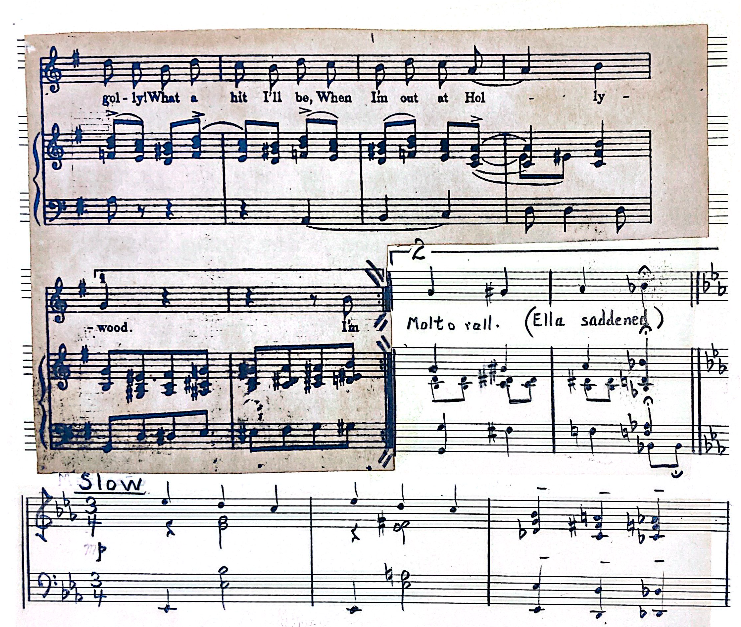
Printed music glued to a page of staff paper is given a different ending in manuscript.


Norman began his career as a cinema pianist and continued to accompany silent films into the 1960s, while also pursuing a career as an organist and composer of mostly sacred music. Norman supposedly gave his library of silent film scores to Arthur Kleiner (Gray), but a search of the Kleiner Collection at the University of Minnesota turns up nothing by or about Norman. If you have any information to add on Norman, we’d love to know. Send us a line at  Director@SFSMA.org.

Adaptations of operas for silent film may seem oxymoronic, but they were very popular. The fans of opera singers–like the “Gerryflappers” who adored singer Geraldine Ferrar–encouraged studios to make films starring opera singers or to make films that follow the plot of an opera with popular actors. In La Boheme, which stars Lillian Gish and John Gilbert, the film uses the opera’s plot scene by scene, but uses “original compositions by William Axt, synchronized by David Mendoza and William Axt.” Oddly, though, it includes few tempo markings for the cues and no actual timings for each cue.

These scores should be of interest to researchers working on compiled scores and performers looking for full scores for accompanying these films. If you use these scores–or any other material on SFSMA–let us know! We’d love to feature you in a post.

Works Cited
Gray, Susan. “Kleiner Silent Film Music Collection.” PRX, 2010. beta.prx.org/stories/51949

Further Reading on Compiled Scores and Opera in Silent Film
American Society of Music Arrangers and Composers. “Compiling Silent Film Scores from Historic Photoplay Music with Rodney Sauer.” June 12, 2021. https://www.facebook.com/asmac.org/videos/1099185557279679.

Citron, Marcia J. When Opera Meets Film. Cambridge University Press, 2010.

Citron, Marcia J.. Opera on Screen. Yale University Press, 2000.

Fawkes, Richard. “Paul Fryer, the Opera Singer and the Silent Film.” Music, Sound, and the Moving Image 3.2 (2009): 261-266.

Esse, Melina, and Karen Henson. “The Silent Diva: Farrar’s Carmen.” Technology and the Diva: Sopranos, Opera and Media from Romanticism to the Digital Age, ed. Karen Henson (Cambridge: Cambridge University Press, 2016), 89-103.

Fawkes, Richard. “The Opera Singer and the Silent Film, and: Carmen on Film: A Cultural History.” Music, Sound, and the Moving Image 3.2 (2009): 261-265.

Grover-Friedlander, Michal. Vocal Apparitions: The Attraction of Cinema to Opera: The Attraction of Cinema to Opera. Princeton University Press, 2005.

Joe, Jeongwon, and Rose Theresa, eds. Between Opera and Cinema. Routledge, 2012.

Leonard, Kendra Preston. “Women’s Compiled Scores in Early Film Music,” in Hidden Harmonies: Women and Music in Popular Entertainment, ed. Paula J. Bishop and Kendra Preston Leonard (University Press of Mississippi, 2023): 53 – 70. https://hcommons.org/deposits/item/hc:55389/

Leonard, Kendra Preston. “Using Resources for Silent Film Music.” Fontes Artis Musicae 63.4 (2016): 259-276. https://hcommons.org/deposits/item/hc:14489/

Mosconi, Elena. “Silent Singers. The Legacy of Opera and Female Stars in Early Italian Cinema.” (2013): 334-352.

Sauer, Rodney. “Photoplay Music: a Reusable Repertory for Silent Film Scoring, 1914-1929.” Americas: A Hemispheric Music Journal 8 (1998): 55.

Schroeder, David. Cinema’s Illusions, Opera’s Allure: the Operatic Impulse in Film. Bloomsbury Publishing, 2016.

Whitmer, Mariana. “Silent Westerns: Hugo Riesenfeld’s Compiled Score for The Covered Wagon (1923).” American Music 36, No. 1, (Spring 2018), 70-101.

Wolf, Stephanie. “Q & A: Mont Alto Orchestra’s Rodney Sauer on Scoring Silent Films.” CPR News, Oct. 30, 2014. https://www.cpr.org/2014/10/30/q-a-mont-alto-orchestras-rodney-sauer-on-scoring-silent-films/
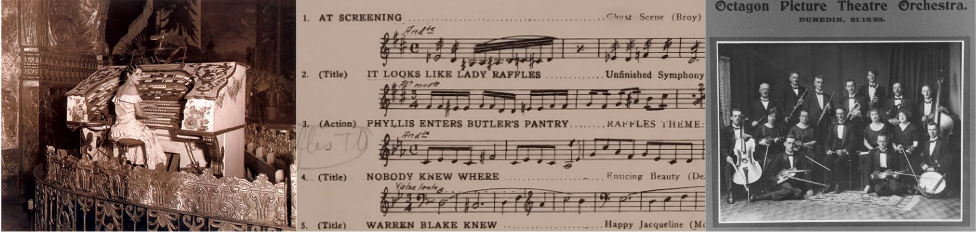
The Hunchback of Notre Dame

Title: The Hunchback of Notre Dame

Author: Paul Norman

Publisher: M. B. Gilbert, 1899; G. Schirmer, 1888; G. Schirmer, 1918; Belwin, Inc., 1925; G. Schirmer, Inc., 1927; G. Schirmer, Inc., 1916; Belwin, Inc., 1916

Series:

Format: Sheet Music

Document type: Musical Score

All authors/contributors: Paul Norman, G. F. Handel, Jules de Sirval, Wm. Scharfenberg, Otto Langey, Maurice Baron, M. Bergunker, William Strasser, Carl Kiefert, Sol P. Levy, S. M. Berg

OCLC Number:

Contents: compiled score for piano

Notes: For Piano, compiled score using pre-existing and original music

Source: Ben Model

SFSMA ID: DGv4YUgw5P

Download: PDF

Ella Cinders

Title: Ella Cinders

Author: Paul Norman

Publisher: Sam Fox, 1925; Skidmore Music Co., 1924; Walter Jacobs, Inc, 1924; Emil Ascher, Inc., 1901; Henry Waterson, Inc., 1924; Walter Jacobs, 1916; Sam Fox, 1918; Jack Mills, 1925; Belwin, Inc., 1920 (2); Walter Jacobs, Inc., 1925; Harms, Inc., 1924; Emil Ascher, Inc., n.d.; Walter Jacobs, Inc., 1918; Walter Jacobs, Inc., 1927 (2); Carl Fischer, 1916; Belwin, Inc., 1918

Series:

Format: Sheet Music

Document type: Musical Score

All authors/contributors: Paul Norman, “Pat” Ballard, Norman Leigh, Max C. Eugene, Russel Robinson, Addy Britt, Jack Little, Harry Tiedman, J. Frank Devine, J. S. Zamecnik, Jimmy Mc Hugh, La Durbin, Harold Potter, Sol P. Levy, Morris Aborn, Hugh W. Schubert, Stephen Jones, Clifford Grey, Leo Feist, Frank Saddler, Irene Varley, Jesse M. Winne, V. M. and C. R. Spaulding, M. L. Lake, Frank H. Grey, Paul Vely

OCLC Number:

Contents: compiled score for piano

Notes: For Piano, compiled score using pre-existing and original music

Source: Ben Model

SFSMA ID: JlQwVikeqt

Download: PDF

Music for Man with a Movie Camera

Update, 18 November 2024: Bossons and Geyer have updated the score, which you can find in two parts below.

Man with a Movie Camera score by Leo Geyer, Prologue-Part 3

Man with a Movie Camera score by Leo Geyer, Parts 4-6 (PDF).

For over a year film historian Richard Bossons has been collaborating with the composer Leo Geyer on a project to recreate the only known score for Dziga Vertov’s film Man with a Movie Camera. In 1995, film scholar Yuri Tsivian published his translation of a set of hand-written notes by Vertov detailing the accompaniment he wanted for his film. Tsivian also translated typewritten cue sheets, thought to have been based on Vertov’s notes, created by three composers–A Grin, N Vaisbain, and V. Jenczijevsky–commissioned by the state cinema organisation Sovkino to create a Conspectus–or cue sheet–for the 1929 premiere. Like cue sheets used in the West, this one contained small snippets of music from the ballet, symphonic, and opera repertoire, and it differs from Vertov’s notes considerably. Nonetheless, the cue sheets offer an important glimpse into Soviet silent film scoring practices, and Bossons’ and Geyer’s score will be a great contribution to the scholarship of silent film music.

Bossons and I have corresponded quite a bit about his project, and has given me permission to share what what he and Geyer have done so far. Bossons writes:

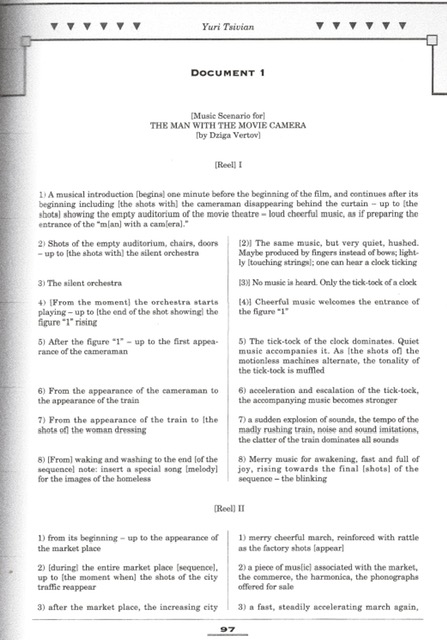
In 1995, Yuri Tsivian published his translation of two documents discovered in the Dziga Vertov archive in the Russian State Archive of Literature and Art, Moscow, in Griffithiana No. 54 (October). Document 1 consists of hand- written notes by Vertov of a ‘Music Scenario’ for the accompaniment of his film.

Document 1 by Yuri Tsivian, showing Vertov’s intentions for music accompanying Man with a Movie Camera

The second document comprises typewritten cue sheets by three composers seemingly based on Vertov’s notes. Sovkino approved this ‘Musical Conspectus’ a week before the first screening of the film in Moscow so it was presumably intended for the orchestras in the two cinemas used for the premiere on April 9, 1929.

There have been many attempts to provide a score for Man with a Movie Camera, but this is the only documented accompaniment to the film. Surprisingly, it has not been recreated before now. Composer Leo Geyer and film historian Richard Bossons have collaborated to turn the cue sheets into a score to mark the 95th anniversary of the premiere in 2024.

Document 2 by Yuri Tsivian showing the music arranged by other composers for Man with a Movie Camera’s Moscow premiere

Bossons wrote a comparison between the musical cues suggested by the official composers and what Vertov wanted. One example:

SEQUENCE 2.

SEQUENCE DIGEST

Silent orchestra, the booth, the projectionist is ready, the film starts running.

SEQUENCE LENGTH: 35s

MUSICAL CHARACTER (movement, dynamics)

Silence, pause for the piano player, who must depict rhythmically the striking of a clock.

INDICATED PIECE

Complete pause.

VERTOV’S NOTES FOR SEQUENCE 2 (his Sequence 3)

  1. The silent orchestra. No music is heard. Only the tick-tock of a clock.

NOTES

Vertov doesn’t specify what should be used to create the clock sound. The Conspectus calls for a piano, which isn’t a suitable instrument to make this sound. As the Goskino #1 orchestra does not include a piano (not visible in the film) the clock is depicted by the sound of two different size wooden blocks.


SEQUENCE 3.

SEQUENCE DIGEST

The conductor waves his baton, the orchestra starts playing.

SEQUENCE LENGTH: 17s

MUSICAL CHARACTER (movement, dynamics)

Bravura.

INDICATED PIECE

Continue the last 6/8 from the Overture to ‘Giralda’.

VERTOV’S NOTES FOR SEQUENCE 3 (his sequence 4)

  1. [From the moment] the orchestra starts playing – up to [the end of the shot showing] the figure ‘1’ rising. Cheerful music welcomes the entrance of the figure ‘1’.

NOTES

The Conspectus ends the music before the ‘1’ starts rising. The beginning and end of this excerpt from ‘Giralda’ was arranged to suit the action of the conductor (though the timing is different to the unknown music being played by the orchestra).

Bossons wrote me recently to say that they had “managed to track down all the pieces except the Miceli and an unknown composer Dorsini.” For the missing works, they are using similar materials for the reconstruction.

We are following the Conspectus closely, but inevitably most of the suggested pieces are either too short (needing additional music ‘in the style of’), or too long (needing an appropriate excerpt to suit the film sequence, and a modified beginning and end). Even the Bodleian has been unable to source some of the more obscure pieces so Leo is having to compose music based on other scores by the composer (eg the Miceli at the end of Reel 1). Additionally, the Massenet, for example, had to be re-arranged to suit the action on screen as it was unsuitable otherwise.

“To avoid copyright on recordings,” Bossons writes, “we are scanning sheet music to get the notation electronically which is reflected in the sound quality (best to listen through headphones or via good speakers!). This means that we can readily obtain the scores for live performance and recording, which is our intention.”

We have completed Reel 1 and half of Reel 2 and I thought you might like to hear what we have done so far. Some of the timing needs to be adjusted, and the sound quality is due to the files being compressed for easier uploading. There is a possibility that we can record the score with an live orchestra in due course. So far, to our surprise, this attempt by three official composers (largely ignoring Vertov’s instructions) works quite well, and adds a period charm to the film. I hope you enjoy it, and I would welcome any comments!

You can listen to the reconstructed score here: https://www.youtube.com/watch?v=L8Lv4gQWpUM.
Bossons writes, “Please note that This is a ‘working model’ based on the Lobster Films restoration of the film, and is not intended to be released. The score will be recorded by an orchestra and published with a new restoration of the film by Eye Film Museum, Amsterdam.”

I can’t wait to hear it!

Library of Congress silent film music digitized

SFSMA board member Paul Allen Sommerfeld has been leading this project to digitize the Silent Film Scores and Arrangements Collection at the Library of Congress! It’s a great new resource for silent film music. Here’s what the library writes:

About this Collection

Music and sound have always served an integral role in film, and the Silent Film Scores and Arrangements digital collection offers unique insight into that development. The collection includes over 3,000 items published or created for use in silent film accompaniment between 1904 – 1927. These items include scores written for specific films, cue sheets that compile melodies for use at certain moments in specific films, and stock music composed or arranged for general use in silent film. Scores and arrangements included in this collection include piano scores, full or reduced orchestral scores, instrumental parts, or just melodic incipits. The majority of the items come from music publishers based in the United States and Europe, but some arrived as copyright submissions by everyday citizens. Composers from the famous to the obscure (many used pseudonyms) appear throughout the collection.

Items in this collection came from copyright submissions, the Jack Butterworth collection, and a gift from Mrs. Charles Moore. Also included, courtesy of the Museum of Modern Art (NYC), are microfilm scans of over 800 items physically held by the museum.

Some additional materials still protected by copyright are available to visitors onsite in the Library’s restricted Stacks website. They will be added to this digital collection as they enter the public domain.

CONTENT WARNING: Some titles and terminology used in this digital collection may reflect racist, sexist, ableist, misogynistic/misogynoir, and xenophobic opinions and attitudes that were deemed acceptable at the time of their publication.

Digitizing the Grauman Collection

I’m delighted to announce that SFSMA will be working with the American Music Research Center (AMRC) at the University of Colorado Boulder and the CU Libraries to digitize the Grauman Theatre Scores Collection and its 3,854 scores available online. This work is supported by a grant from the National Historical Publications and Records Commission. As the AMRC digitizes and uploads pieces, SFSMA will create links to those works, thus helping SFSMA users find items in the CU online collection. I’ll post more details about this partnership as the project gets underway.

CU’s Press release (read original here):

AMRC to Preserve Grauman Film Score Collection
by Charles Wofford

Between 1900 and 1929, when Sid Grauman ran silent films with live orchestral accompaniment in his Hollywood “movie palaces,” he probably never imagined that the thousands of orchestral scores used by his musicians would be recognized as important Americana in their own right. A century later—with a $116,916 grant from the  (NHPRC)—the University of Colorado Boulder’s American Music Research Center (AMRC) is creating a comprehensive digital archive of the Grauman Theatre Scores Collection.

In collaboration with CU Libraries and the Silent Film Sound and Music Archive, the 3,854 scores of the collection will be digitized in multiple high-resolution, full-color formats and made available online at no charge to the public. An additional 192,700 preservation images will help preserve the particularities of the scores, such as handwritten markings from musicians and conductors. “[The Grauman Silent Film Scores Collection] is one of the most important collections anywhere,” says AMRC Director and Professor of Musicology Susan Thomas. “Because of the Grauman Theatre’s centrality in Los Angeles and U.S. film history, these scores can be considered foundational documents—not only for the cultural history of the United States, but also for the sonic construction of U.S. identity in the 20th century.”

The musical representations found in the Grauman collection inspired film composers of the following generation, such as Max Steiner and Alfred Newman; they, in turn, influenced famous film composers from Jerry Goldsmith and Henry Mancini to today’s superstars, including John Williams, Hans Zimmer and others. The collection was donated to the AMRC in 2019 by Rodney Sauer. A pianist, accordionist and director of the Monto Alto Motion Picture Orchestra, Sauer drove the roughly 5,000 pounds of sheet music from Los Angeles to his Louisville, Colorado, home in 2013, narrowly averting catastrophe in the 2013 Boulder County floods. “I want to use this music, I don’t necessarily want to own it,” Sauer previously stated in theColoradan Alumni Magazine.

The AMRC is partnering with Sauer to produce video tutorials to guide performance-oriented musicians on everything from genre selection to timing and period aesthetics. The AMRC is also working to produce music packets for K-12 musicians, especially high school orchestras, who will be able to create their own scores for specific films. “This project is not about moving the music from one dusty attic to another,” says AMRC Assistant Director and Archivist Jessie de la Cruz. “This archive will be a living part of the community.”